Are Wimbledon Debentures a Good Investment?

Wimbledon debentures can generate substantial economic value through their ticket rights and may also increase in value on the secondary market. But neither outcome is guaranteed, and whether a debenture is a good investment depends heavily on the price paid.
A buyer who acquires a debenture at its original issue price has a very different investment case from somebody paying a substantial premium on the secondary market. The value of tickets used personally, net proceeds from tickets sold, remaining years in the series, renewal rights and the eventual resale value of the debenture all need to be considered together.
This article focuses specifically on the investment case and financial risks. For an explanation of the underlying security, ticket entitlement and how the five-year series work, read What is a Wimbledon Debenture?
Investment risk: Wimbledon debentures are high-risk investments. Their value can fall and financial returns are not guaranteed. Anyone considering acquiring the underlying debenture should read the relevant AELTG prospectus and consider taking independent financial, legal and tax advice.
Wimbledon Debentures as an Investment: The Current Numbers
There are two current series relevant to investors looking ahead from 2026:
| Court | Current series | Debentures | Original issue price |
|---|---|---|---|
| Centre Court | 2026-2030 | 2,520 | £116,000 |
| No.1 Court | 2027-2031 | 1,250 | £73,000 |
The previous Centre Court series, covering 2021-2025, was issued at £80,000. The previous No.1 Court series, covering 2022-2026, was issued at £46,000.
That represents an increase in the primary issue price of approximately 45% for Centre Court and 59% for No.1 Court between consecutive series.
Those increases are historically interesting, but they should not be interpreted as evidence that a purchaser will achieve a similar return. The acquisition price, remaining ticket rights and secondary-market conditions can be very different from one series to the next.
The official Wimbledon debenture information provides current information about the debenture series. Our separate guide explains how the AELTC uses money raised from debenture issues.
Where Can a Return From a Wimbledon Debenture Come From?
There are three distinct sources of potential economic value, and it is important not to confuse them.
1. Using the Tickets Yourself
A debenture provides valuable ticket rights throughout its series. If the holder attends Wimbledon personally, those tickets have an economic value even though they do not produce cash income.
This matters because somebody who wants to attend regularly may judge the investment differently from somebody buying solely to generate a financial return.
The experience and facilities attached to the tickets are covered separately in our guide to what is included with a Wimbledon debenture ticket.
2. Selling Individual Debenture Tickets
Debenture tickets are unusual because Wimbledon's current Ticket Terms expressly permit them to be resold, subject to the applicable conditions.
This means a holder can use some Championship days personally and sell tickets for days they do not intend to attend.
The resulting income can offset part of the cost of owning the debenture, but resale values are not fixed. They can vary significantly according to:
- court;
- Championship day and round;
- seat location;
- whether seats are together;
- player interest;
- the number of competing tickets available;
- how close the sale is to the tournament; and
- wider economic and international demand.
It is therefore important to model realistic net sale proceeds, rather than assuming that asking prices or the highest-priced days can be achieved across an entire book of tickets.
Our Wimbledon debenture ticket pricing guide looks specifically at the individual ticket resale market. The wider rules are covered in Can You Resell Wimbledon Tickets?
The current AELTC rules can also be checked directly in Wimbledon's Ticket Terms and Conditions.
3. Selling the Debenture Itself
The underlying debenture can also be sold during its term, subject to the applicable transfer conditions.
Dowgate Capital operates a weekly Wimbledon debenture auction in partnership with the AELTC. Prices are determined by buyers and sellers and can move substantially over time.
See Dowgate Capital's Wimbledon debenture information for details of the secondary market and current auction arrangements.
A secondary-market price can reflect several components at once:
- the value of the Championship tickets still to be received;
- expectations for future ticket resale values;
- the value purchasers attribute to renewal rights;
- scarcity and demand for the particular court;
- any outstanding payment obligations; and
- prevailing market conditions.
It is therefore misleading to treat the difference between the original issue price and a later secondary-market price as pure investment profit without examining what ticket rights and other benefits remain.
Wimbledon 2027
starts in
Find Wimbledon Debenture Tickets
How Should You Calculate the Potential Return?
A useful analysis should consider the whole ownership period rather than simply comparing the purchase price with a later selling price.
In broad terms:
Economic return = value of tickets used personally + net ticket-sale proceeds + net proceeds from selling the debenture + any amount repaid at maturity - acquisition cost - transaction, financing and tax costs.
The calculation becomes more complicated when a debenture is purchased part-way through a series.
| Factor | Question to consider |
|---|---|
| Acquisition price | Are you buying at the original issue price or paying a secondary-market premium? |
| Remaining tickets | How many Championships and individual ticket days remain? |
| Personal use | How many tickets do you genuinely expect to use rather than sell? |
| Ticket-sale proceeds | What could reasonably be achieved after selling costs rather than using headline asking prices? |
| Renewal rights | What rights attach to the debenture and what conditions apply? |
| Exit value | What might another purchaser pay when fewer Championship years remain? |
| Outstanding instalments | Does the purchase price include all amounts still due under the issue? |
| Costs and tax | What brokerage, platform, professional, financing and tax costs apply to your circumstances? |
Can Ticket Sales Pay for the Debenture?
They can offset a substantial part of the ownership cost in favourable market conditions, but it would be unsafe to assume that ticket sales will automatically pay for the debenture.
Different Championship days can have radically different resale values. The men's final, semi-finals and other particularly desirable sessions cannot sensibly be used as a proxy for the value of every ticket in the series.
A robust model should therefore estimate each Championship year separately and use conservative assumptions for individual days.
It should also avoid double counting. A ticket used personally has consumption value to the holder, but it cannot simultaneously generate resale income.
Past ticket-sale performance can be useful evidence when constructing assumptions, but it is not a reliable forecast of future proceeds.
How Important Are Renewal Rights?
Renewal rights can be an important component of a debenture's secondary-market value.
For example, existing holders of the previous No.1 Court series were given the right to apply to renew an equivalent number of debentures for the 2027-2031 issue, subject to the relevant cut-off and issue terms. The current series can similarly carry rights relating to the following issue.
That can create value for somebody wishing to remain a debenture holder over multiple series.
However, a renewal right should not be treated as a guaranteed capital gain. The price and terms of the next issue are determined when that issue is launched, and the economic attractiveness of exercising the right will depend on those terms and prevailing market conditions.
Check the current AELTC debenture documentation and the terms applying to the particular debenture rather than assuming that historic arrangements will continue unchanged.
What Are the Main Investment Risks?
The potential attractions of Wimbledon debentures need to be considered alongside some significant risks.
Secondary-Market Price Risk
A high secondary-market purchase price increases the amount that must ultimately be recovered through ticket value and any later sale of the debenture.
A debenture that represented attractive value to its original subscriber may therefore offer very different economics to a later purchaser paying a substantial premium.
Ticket Resale Risk
Debenture ticket prices are determined by demand. There is no guaranteed selling price and no guarantee that every ticket will sell.
Demand can be affected by the players competing, the draw, seat location, economic conditions, exchange rates, international travel and the number of alternative tickets available.
Liquidity Risk
Wimbledon debentures have an established secondary market, but they are not as liquid as mainstream listed investments.
Dowgate operates regular auctions when debentures are available, but the existence of a market does not guarantee that a holder can sell immediately or at the price they want.
Issuer and Capital Risk
The debenture is an unsecured financial instrument and does not pay conventional annual interest or dividends.
Only the applicable nominal amount is repayable at maturity; the much larger premium associated with the ticket rights is not simply returned to the holder at the end of the series.
The AELTC's own documentation for the 2027-2031 No.1 Court issue categorises the investment as high risk and directs prospective purchasers to read the prospectus before making an investment decision.
You can review the issuer's financial information through Wimbledon's official debenture page and the accounts of The All England Lawn Tennis Ground plc.
Event and Demand Risk
The economics depend heavily on the continued desirability and operation of The Championships.
Unexpected events can affect attendance, international travel, ticket demand or the tournament itself. The cancellation of The Championships in 2020 demonstrated that even exceptionally established sporting events can face circumstances outside their normal planning assumptions.
Rules and Regulatory Risk
The current ability to sell debenture tickets is fundamental to the investment case for many holders, but ticket terms, legislation and regulatory requirements can change.
Ownership and transfer restrictions can also apply to particular purchasers and jurisdictions. Anyone acquiring the underlying debenture should check the current AELTC and broker requirements before committing funds.
Concentration Risk
A Wimbledon debenture represents a large exposure to one issuer, one sporting event and a relatively specialised secondary market.
The Financial Conduct Authority's guidance on high-risk investments explains the importance of understanding potential loss, liquidity and diversification when considering this type of investment risk.
Tax and Transaction Costs
Tax treatment can depend on the owner's circumstances, how the debenture is held and the nature and frequency of transactions involving the debenture and its tickets.
Brokerage, marketplace fees, professional costs and financing costs can also materially reduce headline returns.
Anyone modelling an investment return should therefore work with net proceeds after relevant costs and taxes rather than gross ticket or debenture sale prices.
Are Wimbledon Debentures Comparable With Shares or Bonds?
Only to a limited extent.
A Wimbledon debenture is a financial instrument, but the economic return is closely connected to valuable non-financial rights: tickets to The Championships and access to the debenture experience.
That makes comparisons with conventional bonds, equities or collectible assets imperfect.
Unlike a conventional income-producing bond, the debenture does not provide a normal interest yield. Unlike a share, it does not represent an ownership interest in the business. And unlike many collectibles, an important component of its value - the remaining Championship ticket entitlement - is consumed as each year of the series passes.
For some holders, that consumption is precisely the point: they bought the debenture because they want to attend Wimbledon.
For this reason, Wimbledon debentures arguably have more in common with certain "passion assets" than their name might initially suggest. Their value combines financial characteristics with scarcity, access and personal enjoyment.
That does not make them directly comparable with collectibles such as watches, cars, art or wine, but the comparison provides useful context for understanding why wealthy buyers may value them differently from a conventional bond or equity investment.
How Do Wimbledon Debentures Compare With Luxury Investments?
Wimbledon debentures do not fit neatly into a conventional investment category. They are financial instruments, but much of their economic value derives from something more closely associated with a luxury or "passion" asset: scarce access to one of the world's most prestigious sporting events.
This makes the Knight Frank Luxury Investment Index an interesting point of comparison, although Wimbledon debentures are not included in the index.
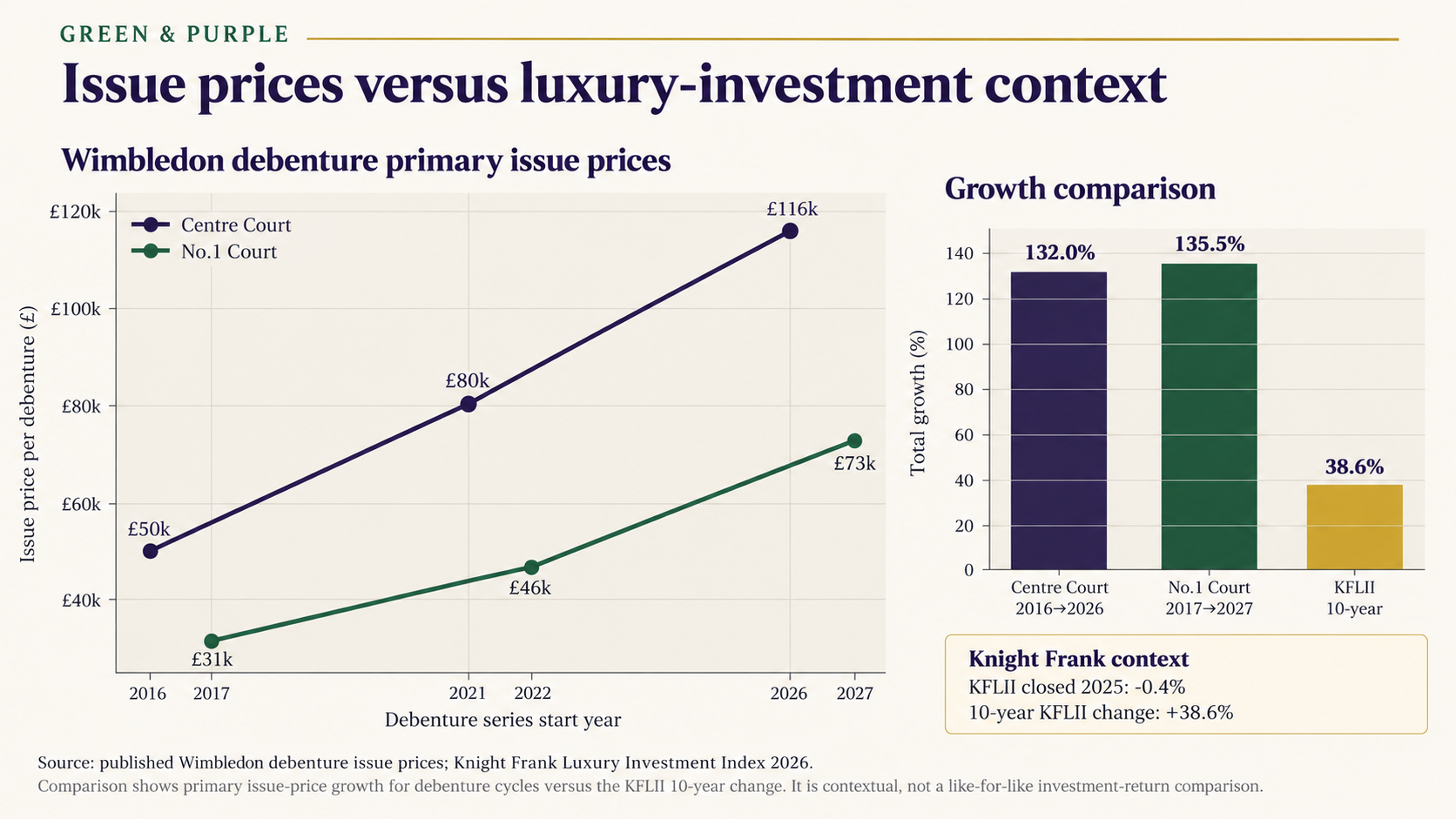
Knight Frank reported that its Luxury Investment Index fell by 0.4% during 2025 after two difficult years for many collectible markets. Over the longer term, however, the index remained 38.6% higher than a decade earlier.
Knight Frank also identified a more selective luxury market, with buyers increasingly favouring rarity, provenance and value rather than assuming that scarce assets will automatically appreciate.
Green & Purple Analysis: How Debenture Issue Prices Have Changed
One way of examining the strength of demand for Wimbledon debentures is to compare the prices set for successive primary issues.
| Court | Earlier issue | Next issue | Current issue | Change across two cycles |
|---|---|---|---|---|
| Centre Court | £50,000 2016-2020 |
£80,000 2021-2025 |
£116,000 2026-2030 |
+132% |
| No.1 Court | £31,000 2017-2021 |
£46,000 2022-2026 |
£73,000 2027-2031 |
+135.5% |
Source: published Wimbledon debenture issue prices. Calculations by Green & Purple.
For context, Knight Frank's Luxury Investment Index increased by 38.6% over its latest ten-year measurement period.
This is not a like-for-like investment-return comparison. The Wimbledon figures measure changes in the primary price of successive five-year debenture issues. They do not measure the total return earned by an individual debenture holder. A debenture also provides valuable ticket rights during its life, while its eventual resale value depends on the remaining Championships, market demand and other factors.
Nevertheless, the figures illustrate the exceptional growth in the price attached to scarce Wimbledon access. Over the past two issue cycles, both Centre Court and No.1 Court primary issue prices have more than doubled.
That appears consistent with a wider trend identified by Knight Frank: wealthy buyers are becoming increasingly selective and concentrating demand on assets with genuine scarcity and a strong experiential or emotional component.
Wimbledon debentures have both. There are only 2,520 Centre Court debentures and 1,250 No.1 Court debentures, while ownership provides not just a transferable asset but repeated access to The Championships.
This combination may help explain why demand for Wimbledon debentures has remained strong even during periods when some traditional collectible markets have weakened.
Does Buying at the Original Issue Price Make a Difference?
Potentially, yes.
Recent primary issue prices have subsequently been followed by strong secondary-market demand. However, that does not mean the same return is available to somebody entering later.
A secondary-market purchaser needs to consider both:
- the premium being paid above the original issue price; and
- the number and value of the ticket rights still remaining.
The appropriate comparison is therefore not simply:
secondary price minus original issue price.
It is the total economic value received by the particular owner compared with the total amount that owner actually committed.
What Should You Check Before Buying a Wimbledon Debenture?
Before acquiring a debenture on the secondary market, establish:
- the exact court and debenture series;
- the purchase price and any further instalments or liabilities;
- how many Championships remain;
- which ticket rights remain attached to the debenture;
- whether any future tickets have already been transferred or otherwise committed;
- the applicable renewal rights and cut-off dates;
- the transfer and registration requirements;
- whether any jurisdictional restrictions apply to you;
- the likely costs of buying and eventually selling; and
- the tax treatment applicable to your circumstances.
For the underlying purchase and transfer process, consult the AELTC's official debenture information and Dowgate Capital's secondary-market information.
So, Are Wimbledon Debentures a Good Investment?
There is no universal answer.
For a purchaser focused purely on financial return, the most important variables are the acquisition price, realistic net ticket-sale income, the value of the remaining ticket rights and the price that might eventually be achieved when the debenture is sold.
Paying a high secondary-market premium can make that calculation very different from subscribing to a new issue at its original price.
For somebody who genuinely wants to attend Wimbledon, the calculation is different again. Tickets used personally provide substantial non-cash value, and selling unwanted days may offset some of the ownership cost.
This combination of financial and personal value is what makes Wimbledon debentures unusual. It is also why a simple historic return percentage is a poor basis on which to decide whether one represents good value today.
Past increases in issue prices and secondary-market values demonstrate that demand has historically been strong. They do not demonstrate that future prices or ticket-sale proceeds will rise.
Independent Sources and Further Reading
- The Championships, Wimbledon - official debenture information
- Dowgate Capital - Wimbledon debenture secondary market
- AELTG - 2027-2031 No.1 Court Debenture Issue guidance
- Financial Conduct Authority - understanding high-risk investments
Important: This article is provided for general information only. It is not investment, financial, legal or tax advice and does not constitute a recommendation, offer or invitation to acquire or dispose of a Wimbledon debenture. Green & Purple provides a marketplace for individual Wimbledon debenture tickets; it does not sell the underlying Wimbledon debentures. Anyone considering acquiring or selling a debenture should read the applicable prospectus and obtain appropriate independent professional advice.
Thinking about Wimbledon tickets?
Green & Purple is the secure marketplace for buying and selling Wimbledon debenture tickets.
Need Help?
Need help? Visit our FAQs or contact us.
News and articles

Bo Ponomari Wins Green & Purple Photography Prize 2026
October 2026
The Month Ahead

October 2026 Tennis Preview: What It Means for Wimbledon